Next-generation DSA powered by wide-area EMT simulation
What Is EMT-DSA?
EMT-DSA is EMTP’s Dynamic Security Assessment solution — an automated, near-real-time platform that evaluates power grid stability using full electromagnetic transient (EMT) simulations. Unlike traditional DSA tools that rely on simplified phasor-domain (RMS) models, EMT-DSA delivers the accuracy your modern grid demands.
Grids with high shares of renewable energy and inverter-based resources (IBRs) or HVDC behave in ways that RMS tools simply cannot capture reliably. Real-world blackouts have occurred that RMS simulations failed to predict. EMT-DSA closes this critical gap.
Why EMT over RMS?
Traditional DSA tools are built on phasor-domain (RMS) modeling — a 30-year-old approach that makes critical simplifications. As grids modernize, these simplifications become liabilities:
- Inverter-Based Resources (IBR): RMS tools cannot accurately simulate the fast-switching dynamics of solar, wind, and battery storage. EMT handles them natively.
- Weak Grids: Low-inertia and low short-circuit strength environments cause RMS models to diverge from reality. EMT-DSA remains accurate.
- Complex Control Interactions: Modern grid equipment interacts in ways that require sub-millisecond modeling resolution — only possible with EMT.
- Proven in Practice: Multiple real-world events and blackouts were only reproducible with EMT simulations, not RMS.
Key Features
Online & Offline Operating Modes
Adapt to your operational workflow with two complementary modes:
- Online Mode: The digital twin is automatically re-initialized every 30 minutes using live state estimator data from your EMS/SCADA system. A pre-defined set of contingencies is then simulated automatically — keeping your control room always up to date.
- Offline Mode: Start from recorded or forecasted grid snapshots for in-depth post-event analysis, scenario planning, or contingency studies — without waiting for the next online cycle.
Seamless EMS/SCADA Integration
EMT-DSA connects directly to your Energy Management System. It imports real-time grid data in industry-standard RAW and CIM formats, automatically maps state estimator results to the EMT model, and updates generator setpoints, transformer taps, load levels, and reactive compensation — all without manual intervention.
EMTP uses its load-flow solver to match the state estimator data.
Wide-Area, Large-Scale Simulation
Simulate your entire transmission network — not just a local area. EMT-DSA has been validated on grids of more than 8,000 electrical nodes and hundreds of synchronous generators, wind and solar parks. Adaptive modeling automatically simplifies remote zones, focusing computation where it matters most.
Parallel High-Performance Computing
Every contingency runs as a fully independent parallel process across your compute cluster. This means your X-contingency cycle runs in minutes, not hours:
- CPU Parallelism: Each contingency runs on multiple CPU cores simultaneously. For 50 contingencies parallelized on 4 threads each, 200+ cores are utilized in parallel.
- Multi-Server Architecture: Distribute simulations across as many servers as needed. EMT-DSA’s scheduler automatically assigns cases to available resources.
- Scalable: Add compute capacity at any time. The architecture is designed to scale with your grid and your ambition.
Comprehensive Stability Assessment
Each DSA cycle evaluates a full spectrum of stability criteria:
- Transient rotor angle stability
- Transient voltage violations
- Transient frequency deviations
- Damping of low-frequency oscillations
- Pre-contingency load-flow violations (bus voltage & branch current)
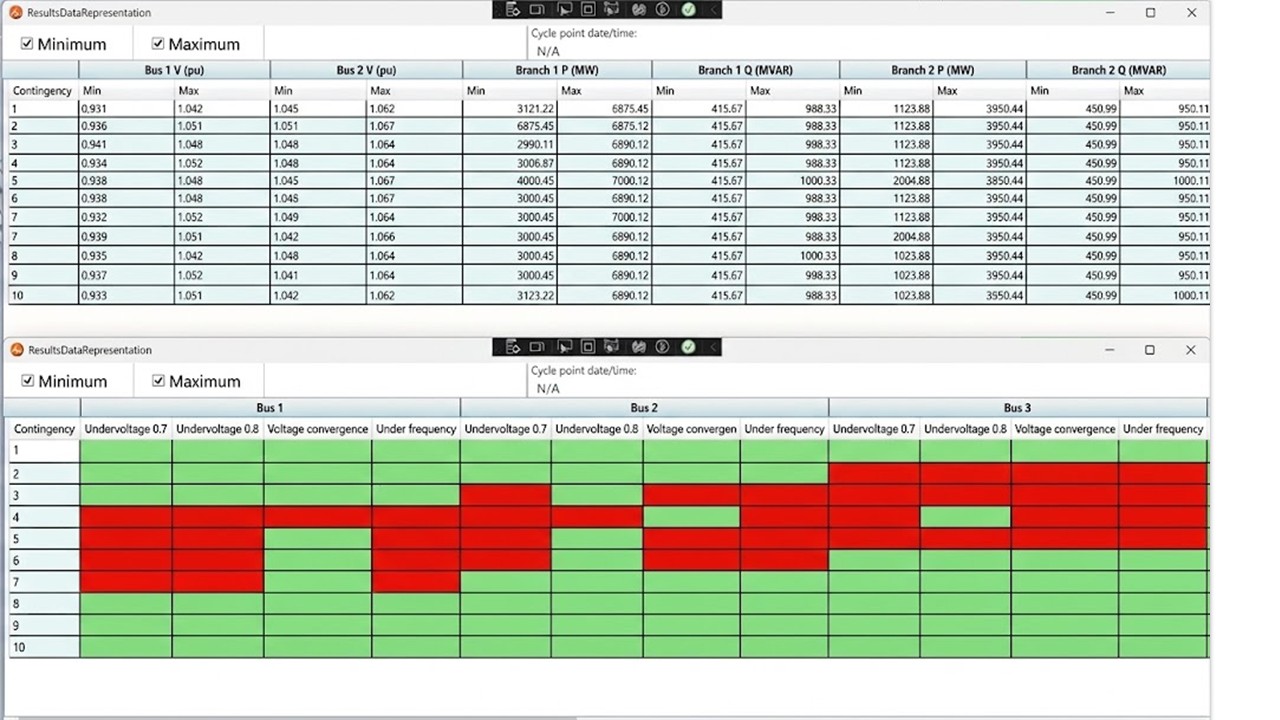
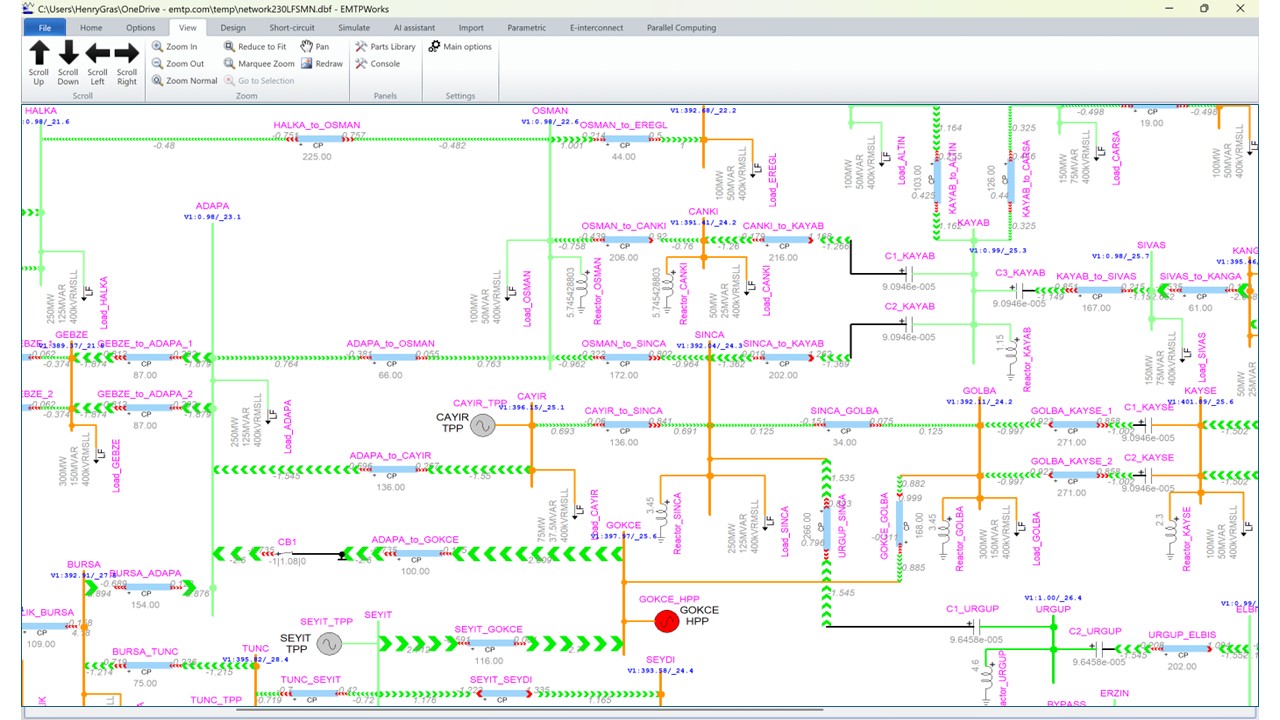
Results are automatically analyzed against user-defined thresholds — violations are flagged, ranked, and visualized directly on the network diagram.
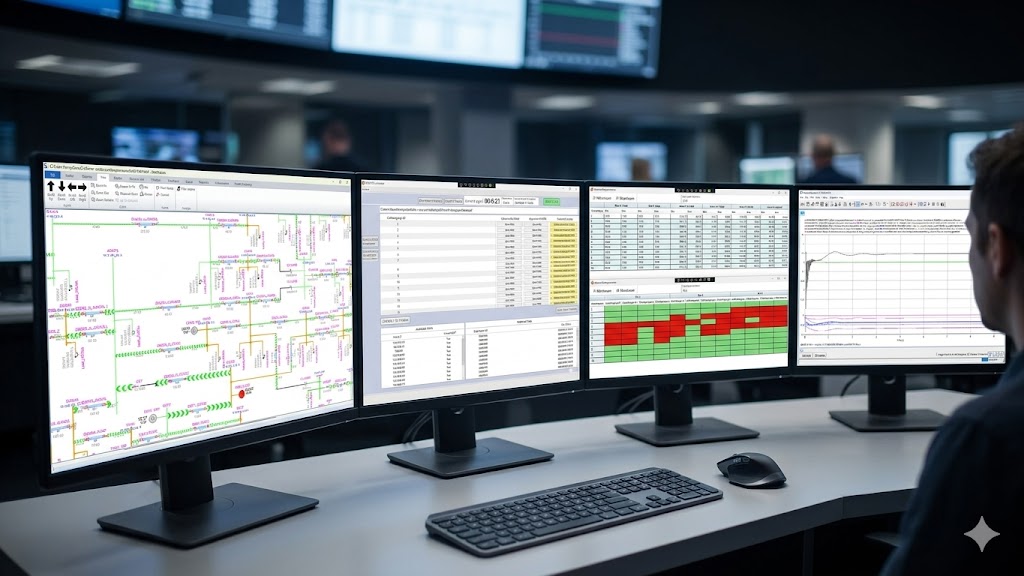
Results are displayed in summary tables.
Intuitive GUI & Visualization
Operators don’t need to be EMT experts. EMT-DSA includes a purpose-built graphical interface for:
- Analysis Settings: Configure modeling fidelity per zone, contingency sets, and hardware allocation from a single window.
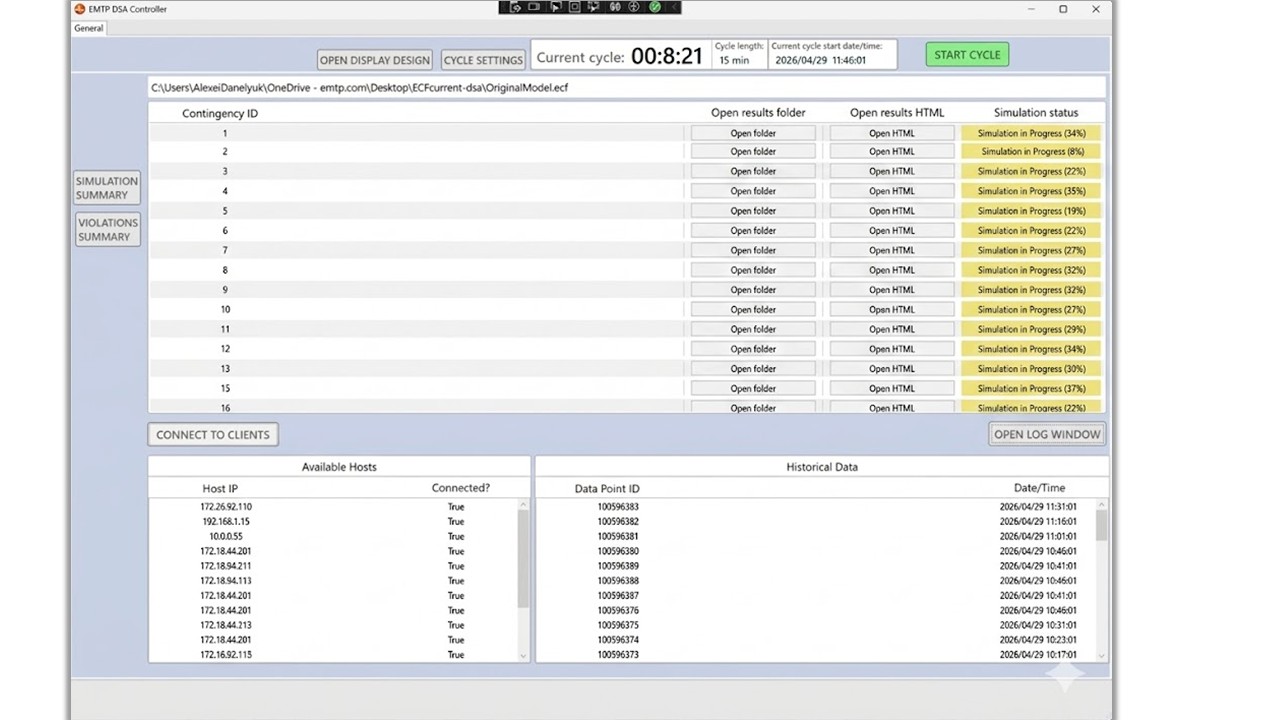
Cycle Control: Monitor the real-time progress of each simulation step — know exactly what is running, what is pending, and what is complete.
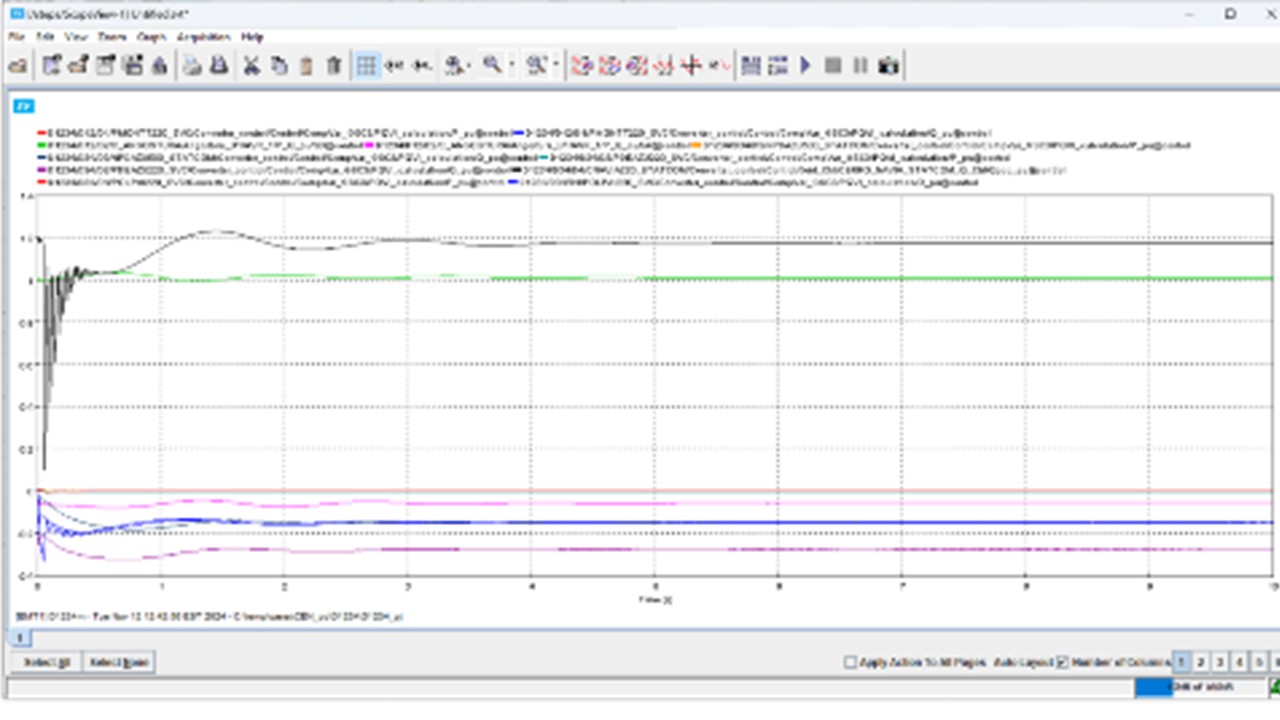
Results Viewer: Inspect time-domain waveforms, summary tables, and limit violations. Active and reactive power flows are overlaid on the circuit diagram with color-coded violation indicators.