Access to EMTP user presentations, webinars, and slide deck presentations.
11 presentations for Transmission System:
Author(s): Umesh Sen - Power Grid
Type:Technical Presentation
Downloaded: 3
Date: 2021-06-21
Abstract
To meet the increasing power demand, a number of extra high voltage (EHV) transmission lines is being added to the power system network, which enhances the complexity of power system network. It is es... see moresential duty of power engineer to fulfill the growing demand ensuring the reliability, stability & security of GRID. Transient simulation tools like EMTP play a vital role to provide the flexibility to power engineer for simulating/studying the various case scenarios which couldn’t be simulate in physical power system.
Such tools eventually help power engineer to build a sustainable and secure GRID. In POWERGRID, being a central transmission utility, various studies are being carried out to arrive the technical particular of new transmission system and optimize or fine tuning of existing system. Some of them i.e. Transient Recovery Voltage (TRV) study of 1200kV Transmission network, Smart Power from insulated earth wire of EHV transmission line and 1200kV Transformer Inrush current study are discussed in presentation. 1200kV National Test Station was established & successfully charged along with the transmission line in state of BINA in India.
TRV study was carried out for assessment of various test duties of 1200kV Circuit Breaker. Presentation cover the detailed discussion of 1200kV TRV study and a brief about the facilities like HIL, HVDC control Replica setup, STATCOM replica setup available at Powergrid Advanced Research and Technology Centre (PARTeC).
Author(s): Kumaraguru Prabakar
Type:Technical Presentation
Date: 2021-03-05
Abstract
This presentation will discuss the need for using wide-band models to model the traveling wave phenomenon in the distribution system. The distribution system is going through significant changes. On... see moree of them is the high penetration of inverter-based distributed energy resources in the distribution system. Due to this high penetration, there is a need for a better protection system. Multiple organizations are working on creating novel protection techniques for distribution systems with high penetration of inverter-based DERs. One such innovative method is the use of traveling waves to detect and locate faults. Transmission system protection utilizes this approach, and commercial solutions exist for the transmission system. Using this approach in the distribution system is not straightforward and presents some challenges for implementation.
Author(s): Ulas Karaagac, Hong Kong Polytechnic University
Type:Technical Presentation
Date: 2020-11-20
Abstract
<h6 class="text-black" style="padding-bottom: 30px; padding-top: 30px; text-align: justify;">Speaker: <strong>Ulas Karaagac</stro... see moreng>, <em>Hong Kong Polytechnic University</em></h6> <p class="text-black">Subsynchronous control interaction (SSCI) is the interaction between the power electronics control and the series compensated transmission system that occurs at frequencies below the system nominal frequency. SSCI may occur between the doubly-fed induction generator (DFIG) control system and the series compensated transmission line, to which the wind park (WP) is connected. Not only the DFIG control system parameters, but also the WP operating conditions have significant impact on SSCI.<br><br>This presentation will demonstrate the impact of WP operating conditions and DFIG control system parameters on SSCI. Guidelines will be also presented for modifying the DFIG control system parameters to ensure safe operation and acceptable transient responses due to faults. In addition, the accuracies of various analytical tools used for SSCI problem identification will be discussed.</p>
Author(s): Sébastien DENNETIERE, RTE – Centre National d’Expertise Réseaux
Type:Technical Presentation
Date: 2020-11-20
Abstract
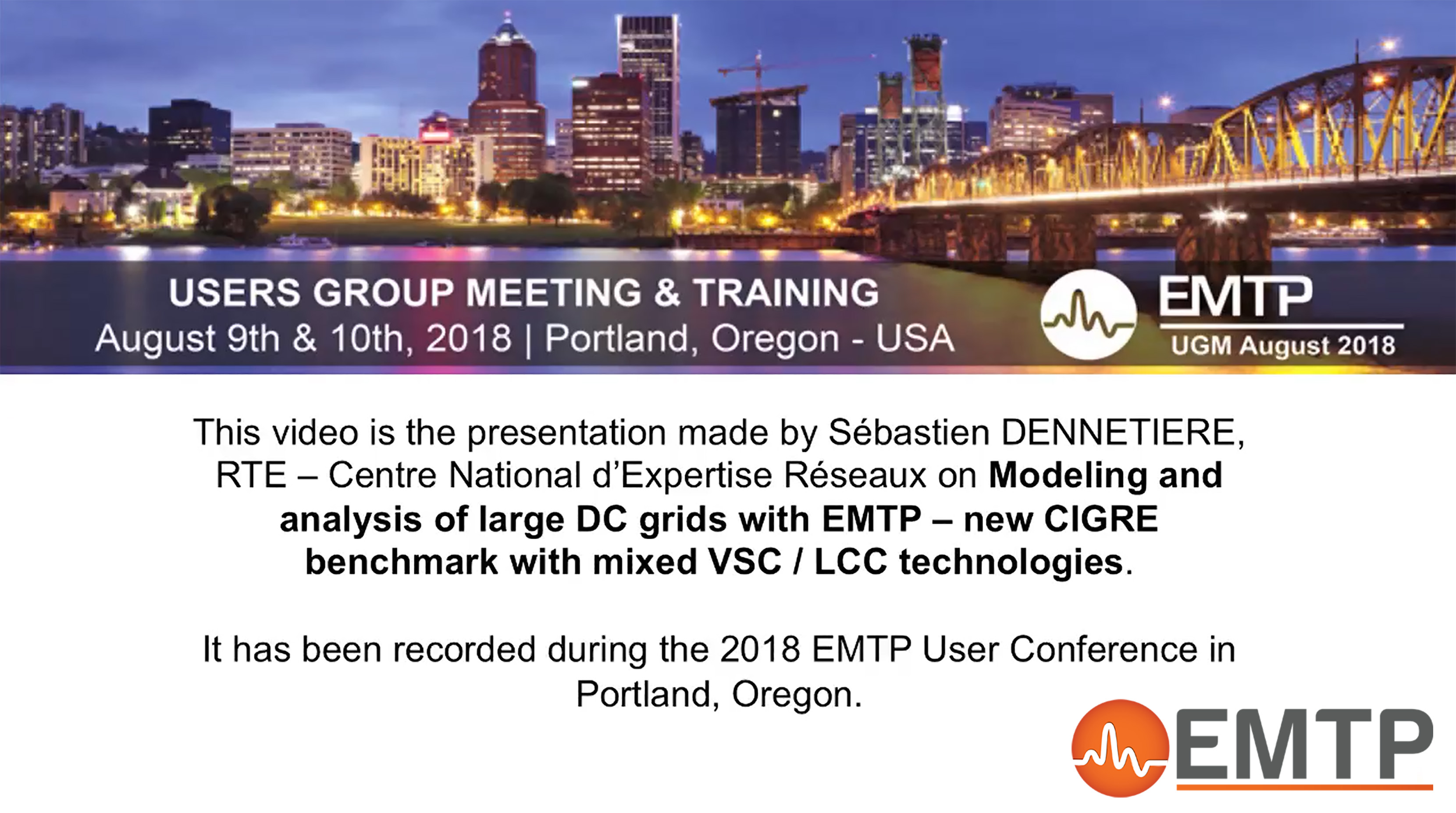
<h6 class="text-black" style="padding-bottom: 30px; padding-top: 30px; text-align: justify;">Speaker: <strong>Sébastien DENNETIERE&... see morelt;/strong>, <em>RTE – Centre National d’Expertise Réseaux</em></h6> <p class="text-black">A high voltage direct current (HVDC) grid is a power transmission system which consists of multiple HVDC terminals interconnected through DC lines. The advantages of a DC grid are increasing system flexibility and reliability and providing redundancy at a lower cost by sharing resources, resulting in lower power losses. In order to test and compare technical solutions that can be applied on a realistic DC grid, CIGRE B4 Study committee decided to propose a VSC based DC Grid test system with ac and dc parts with all input data suitable for EMT simulation. This first benchmark has been developed in 2014 in EMTP and different simulation tools in order to validate the completeness of data provided in the Technical Brochure #604. The test system has 11 AC/DC VSC converters, 2 DC/DC converters and 2 DC voltage levels (±400kV and ±200kV).<br><br> The main purpose of the test system is to provide a common basis for all CIGRE SC B4 WGs that work on the research of DC grids. This benchmark model generated a high interest. Some limitations on this benchmark (topology, equipment included…) have been identified so far. In order to provide common study platforms to meet the most different HVDC grid study purposes and needs, seven HVDC grid test models have been established by the B4-72 CIGRE WG. These models have been designed to cover most HVDC grid applications including collection, integration and transmissions of onshore/offshore renewable power generation over long distance, LCC-HVDC grids, LCC-VSC hybrid HVDC grids, AC system interconnections for different types of studies with appropriate and applicable sizes. The presentation will address the issues related to the modeling of the largest DC grid test system proposed by this WG. This grid model includes 22 VSC converter stations, 4 LCC converter stations, PV and wind generations. </p>
Author(s): Hani SAAD, Ph.D. student
Type:Technical Presentation
Date: 2020-11-20
![[HVDC]_MODELING OF HVDC-MMC TRANSMISSION SYSTEM FOR ELECTROMAGNETIC TRANSIENTS](https://www.emtp.com/system/files/imagecache/presentation/HVDC-MMC_Hani_SAAD_illustr.jpg "[HVDC]_MODELING OF HVDC-MMC TRANSMISSION SYSTEM FOR ELECTROMAGNETIC TRANSIENTS")
![[R&D]_EMTP : Recherche et développement](https://www.emtp.com/system/files/imagecache/presentation/slide1_1.jpg "[R&D]_EMTP : Recherche et développement")
![[Protection_Devices]_Étude des courants coupés par les sectionneurs de changemen](https://www.emtp.com/system/files/imagecache/presentation/TechnicalPresentation1.jpg "[Protection_Devices]_Étude des courants coupés par les sectionneurs de changemen")