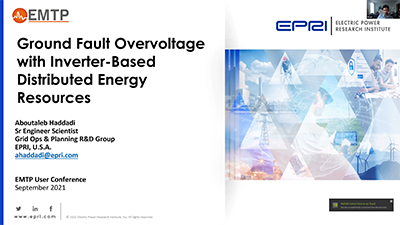
Access to EMTP user presentations, webinars, and slide deck presentations.
page 4 of 4
19 presentations for cable:
Author(s): Ilhan Kocar
Type:Technical Presentation
Date: 2020-12-14
The new frequency dependent line and cable model: Wideband Model
Abstract
<p>This presentation introduces the new Windband Model, capable of eliminates the modeling problems encountered with the existing ULM approach.</p><p>
Ov... see more
Author(s): Ilhan Kocar, Polytechnique Montréal
Type:Technical Presentation
Date: 2020-11-20
The new frequency dependent line and cable model: wideband model
Abstract
<h6 class="text-black" style="padding-bottom: 30px; padding-top: 30px; text-align: justify;">Speaker: <strong>Ilhan Kocar</strong... see more
![[Electromagnetic_Interference]_Coupling between transmission underground cables](https://www.emtp.com/system/files/imagecache/presentation/pdf1_3.jpg "[Electromagnetic_Interference]_Coupling between transmission underground cables")
Author(s): Alain XEMARD, EDF R&D
Type:Technical Presentation
Date: 2020-11-20
![[Network_Analysis]_EMTP studies performed to insert long AC cables in the French](https://www.emtp.com/system/files/imagecache/presentation/Long_Cable_AC.PNG "[Network_Analysis]_EMTP studies performed to insert long AC cables in the French")
Author(s): Simon DESCHANVRES and Yannick VERNAY RTE, CNER, Substations Department
Type:Technical Presentation
Date: 2020-11-20

![[R&D]_EMTP : Recherche et développement](https://www.emtp.com/system/files/imagecache/presentation/slide1_1.jpg "[R&D]_EMTP : Recherche et développement")
![[Protection_Devices]_Étude des courants coupés par les sectionneurs de changemen](https://www.emtp.com/system/files/imagecache/presentation/TechnicalPresentation1.jpg "[Protection_Devices]_Étude des courants coupés par les sectionneurs de changemen")