Access to EMTP user presentations, webinars, and slide deck presentations.
60 presentations for DER:
Author(s): N.K. Nathan
Type:Technical Presentation
Date: 2021-09-01
Abstract
Transient enclosure voltage (TEV) also known as Transient ground potential rise (TGPR) is a special case of VFTO. This phenomenon refers to short rise time, short duration high voltage transient which... see more appear on earthed enclosure of GIS. This is mainly through the coupling of internal transients on conductor refracted to the enclosure at enclosure discontinuities such as air terminations, insulated flanges at GIS/Cable interfaces and some current transformers. Primarily disconnector switch operations are causes of VFTO and SF6-Air bushing seems to be the most significant source of TEV.
Observation of sparking between grounded enclosure and support structure, failure of protective devices, inadvertent operation of relays etc are common malfunction of TEV. Despite proper grounding this phenomenon indicates presence of high potentials on GIS enclosures which raises the issue of equipment protection, migration of these transients to adjacent equipment and shock hazards.
TEV in 400kV GIS substation due to “disconnector switch operation” was studied and simulations performed for GIS model with the equivalent resistance of ground grid, resistance and inductance of grounding strip using EMTP. The presentation summarizes the results of study needed for a 400kV GIS substation in India to ascertain VFTO induced TGPR level. The study was carried out by modeling all GIS equipment, enclosure in EMTP and careful consideration of grounding system model. The results of the study were analyzed to decide on the requirement of mitigation methods to ensure the permissible level of TEV.
Tag(s): gis, vfto, very fast transient
Author(s): N.K. Nathan
Type:Technical Presentation
Date: 2021-09-01
Abstract
Transient enclosure voltage (TEV) also known as Transient ground potential rise (TGPR) is a special case of VFTO. This phenomenon refers to short rise time, short duration high voltage transient which... see more appear on earthed enclosure of GIS. This is mainly through the coupling of internal transients on conductor refracted to the enclosure at enclosure discontinuities such as air terminations, insulated flanges at GIS/Cable interfaces and some current transformers. Primarily disconnector switch operations are causes of VFTO and SF6-Air bushing seems to be the most significant source of TEV.
Observation of sparking between grounded enclosure and support structure, failure of protective devices, inadvertent operation of relays etc are common malfunction of TEV. Despite proper grounding this phenomenon indicates presence of high potentials on GIS enclosures which raises the issue of equipment protection, migration of these transients to adjacent equipment and shock hazards.
TEV in 400kV GIS substation due to “disconnector switch operation” was studied and simulations performed for GIS model with the equivalent resistance of ground grid, resistance and inductance of grounding strip using EMTP. The presentation summarizes the results of study needed for a 400kV GIS substation in India to ascertain VFTO induced TGPR level. The study was carried out by modeling all GIS equipment, enclosure in EMTP and careful consideration of grounding system model. The results of the study were analyzed to decide on the requirement of mitigation methods to ensure the permissible level of TEV.
Tag(s): gis, vfto, very fast transient
Author(s): Neeraj Patel - Adani Power
Type:Technical Presentation
Downloaded: 3
Date: 2021-06-21
Abstract
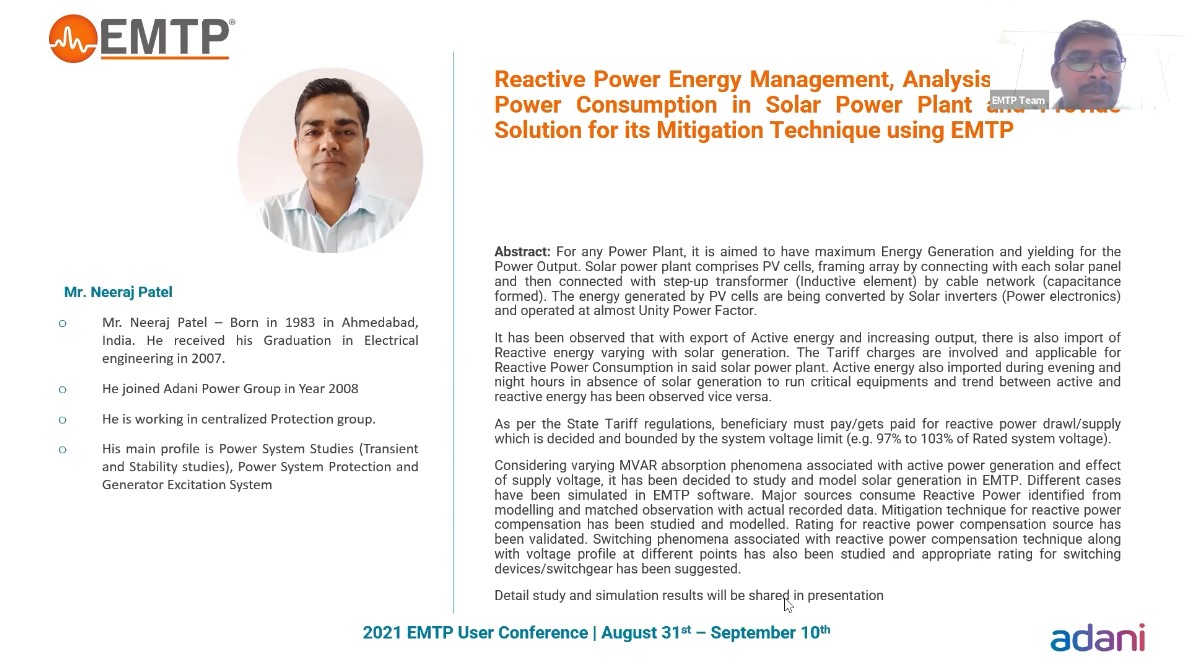
Unsuccessful auto reclosure has been observed in 765 kV HVAC transmission lines connected with Generation Bus. Back up Impedance Protection of Line reactor triggered during AR dead time due to power f... see morerequency oscillations in faulty phase (disconnected phase). It triggered tripping of Non Switchable Line Reactor at one end, which resulted tripping of 765 kV HVAC Line and avoidable Generation loss.
These Unsuccessful AR operations triggered us to study and model entire phenomena in Power System Analysis software (EMTP).
Initially, two circuits of 765 kV Transmission Line commissioned between Generation Station and Transmission Station with Line Reactor and NGR in both line at either end. Successful auto reclosure observed during single-phase faults on these lines. Intermediate Switching station constructed and both lines were divided in 4 section as per new requirement. Same configuration (rating) of Line Reactor and NGR adopted at newly constructed station on each line. Unsuccessful AR observed during AR running cycle on these lines after new configuration. Backup Impedance protection of Line Reactor found operated during AR Dead time.
Different sets of simulations has been carried out to understand the phenomena:
- Single Phase fault and Auto reclosure in 765 kV Transmission line in different section of entire corridor with Varying Shunt compensation (Value of Line Reactor)
- Different NGR values and observations for above simulations
- Trip the Line Reactor Breaker during Auto Reclosure Phenomena to avoid operation of Backup Impedance protection and its consequences
After EMTP Simulations and study, it was concluded that:
- Line Reactor (Degree of compensation) should be adjusted with adequate value while line length altered from its original design.
- NGR re-sizing can address the issues at some extent. Suitable value of NGR (based on Line Length and amount of shunt compensation) should be employed
Appropriate Solution and mitigation suggested after detail simulation & study.
Tag(s): single pole, analysis, auto reclosure, line reactor
Author(s): Jin Yang - Ener-Phase Solutions
Type:Technical Presentation
Date: 2021-06-21
Abstract
A case study will be presented demonstrating modeling of overvoltage in a moderately sized system involving medium voltage vacuum breakers, cables and transformers. The focus is on simulating high fre... see morequency overvoltage generated by circuit breaker prestrikes and re-ignitions and evaluating the impacts on transformer insulation.
-Results obtained from a customized breaker TRV model which is capable of controlling the capability of switching high frequency current will be presented.
-The methodology of analyzing severity of overvoltage in the frequency domain was applied in this project. Results and discussions regarding frequency domain analysis will be shared.
-Simulation results regarding typical system configurations with variation of key parameters such as cable lengths, load power factors will be briefly presented.
-Application of EMTP study results in assisting equipment specification, as well as overvoltage mitigation methods including optimizing switching sequences, necessity of snubber circuits will be discussed.
-Case specific strategies to improve simulation speed and work flow with EMTP will be introduced and discussed.
Author(s): Sofía Aparicio, Andrea Pizzini, Nicolás Morales - UTE
Type:Technical Presentation
Date: 2021-06-21
Abstract
In order to obtain the distances required to perform live working maintenance on the Uruguayan transmission network under secure conditions, electromagnetic transient (EMT) studies are conducted to ob... see moretain the maximum switching overvoltage that can be found in 500-150 kV transmission network. Two different approaches were considered for these studies. On one hand, a simple approach is used, analyzing line switching transients on simplified two line network models. On the other hand, a detailed approach is considered, analyzing line switching overvoltage transients on a complete network model.
This complete model considers 500 kV and 150 kV overhead lines, 500/150 kV transformers, cables, reactive power shunt compensation, hydraulic and thermal generators. Electromagnetic transient studies and the complete network model are performed in EMTP software. Finally, a comparison between the results obtained considering each approach is performed.



![[R&D]_EMTP : Recherche et développement](https://www.emtp.com/system/files/imagecache/presentation/slide1_1.jpg "[R&D]_EMTP : Recherche et développement")
![[Protection_Devices]_Étude des courants coupés par les sectionneurs de changemen](https://www.emtp.com/system/files/imagecache/presentation/TechnicalPresentation1.jpg "[Protection_Devices]_Étude des courants coupés par les sectionneurs de changemen")