Access to EMTP user presentations, webinars, and slide deck presentations.
20 presentations for Faults:
Author(s): Frédéric Colas
Type:Technical Presentation
Date: 2021-09-05
Abstract
In the context of the simulation of an electrical network, different models of lines / cables are available. Among these, we can cite the PI models, the frequency dependent models (FD-Line) or the mod... see moreels called Wideband. This last type of modeling is considered in the power system community as a sufficiently precise model to simulate the behavior of the cable under non-symmetrical faults and more particularly in the case of underground or submarine cables. However, the parameters of this type of model are generally still calculated from a standard geometry.
In this presentation, a methodology to obtain, from the software FEMM, the cable data parameters needed for EMTP will be presented. This methodology allows to easily obtain the correct parameters from specific cable geometry.
Tag(s): fem, cable, parameters
Author(s): Mr. Suyash Kulkarni - Mr. Suved - M. Pakade
Type:Technical Presentation
Date: 2021-09-03
Abstract
In a new 2X25 kV System, Scott transformer is used as a traction transformer and to supply the power to the railway traction system. It is protected using the percentage differential relay.
... see more
However, region from the low voltage side of the Scott transformer to the first autotransformer is unprotected at the field and to protect the system during fault on this region is very important. Thus, development of protection scheme is required. Herein, we modeled 2X25kV traction system in EMTP, simulate faults and developed a specific relationship to provide the protection for this scheme. We have taken the current input from feeder current transformers and observed its current during the faults.
This performance of this scheme is verified using EMTP. Further, impedance to distance ratio is non-linear due to the autotransformer between catenary, rail and feeders in 2x25kV railway traction system. To observe this behavior as per field details and provide the accurate relay setting, we simulate the faults over the length of protected line in EMTP and field test are carried out. In the event of a fault on unprotected region and on the protected line, trip occurs and relay recorded fault details at the field.
Tag(s): Fault Detection, protection, railway, traction
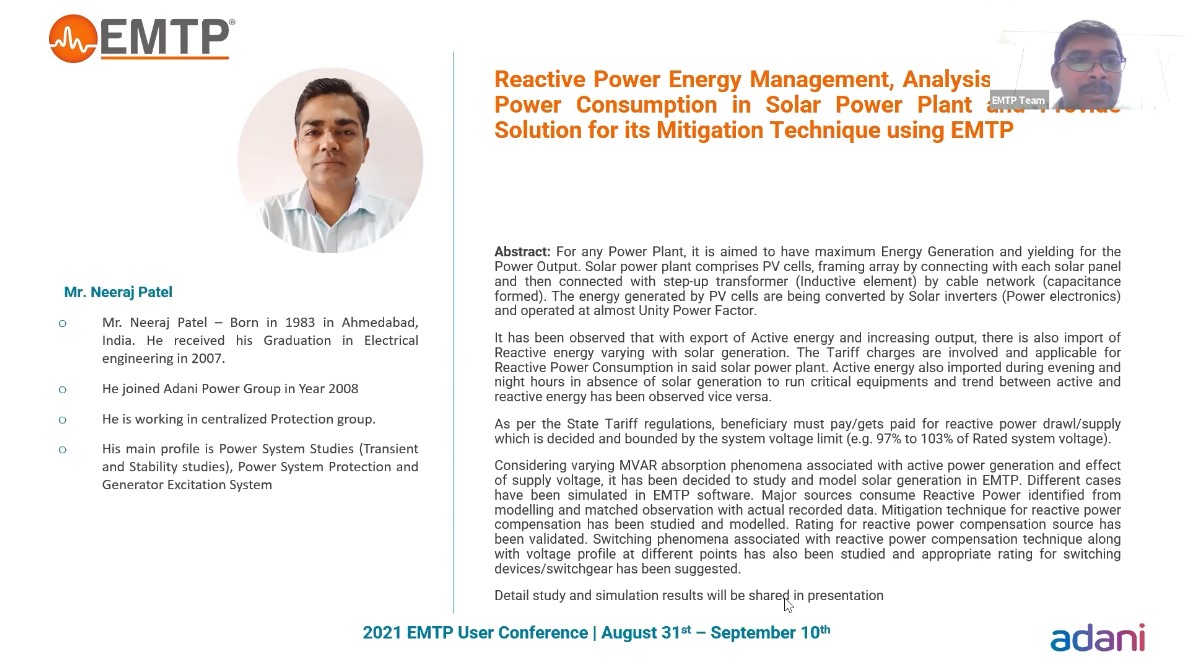
Author(s): Neeraj Patel - Adani Power
Type:Technical Presentation
Downloaded: 3
Date: 2021-06-21
Abstract
Unsuccessful auto reclosure has been observed in 765 kV HVAC transmission lines connected with Generation Bus. Back up Impedance Protection of Line reactor triggered during AR dead time due to power f... see morerequency oscillations in faulty phase (disconnected phase). It triggered tripping of Non Switchable Line Reactor at one end, which resulted tripping of 765 kV HVAC Line and avoidable Generation loss.
These Unsuccessful AR operations triggered us to study and model entire phenomena in Power System Analysis software (EMTP).
Initially, two circuits of 765 kV Transmission Line commissioned between Generation Station and Transmission Station with Line Reactor and NGR in both line at either end. Successful auto reclosure observed during single-phase faults on these lines. Intermediate Switching station constructed and both lines were divided in 4 section as per new requirement. Same configuration (rating) of Line Reactor and NGR adopted at newly constructed station on each line. Unsuccessful AR observed during AR running cycle on these lines after new configuration. Backup Impedance protection of Line Reactor found operated during AR Dead time.
Different sets of simulations has been carried out to understand the phenomena:
- Single Phase fault and Auto reclosure in 765 kV Transmission line in different section of entire corridor with Varying Shunt compensation (Value of Line Reactor)
- Different NGR values and observations for above simulations
- Trip the Line Reactor Breaker during Auto Reclosure Phenomena to avoid operation of Backup Impedance protection and its consequences
After EMTP Simulations and study, it was concluded that:
- Line Reactor (Degree of compensation) should be adjusted with adequate value while line length altered from its original design.
- NGR re-sizing can address the issues at some extent. Suitable value of NGR (based on Line Length and amount of shunt compensation) should be employed
Appropriate Solution and mitigation suggested after detail simulation & study.
Tag(s): single pole, analysis, auto reclosure, line reactor
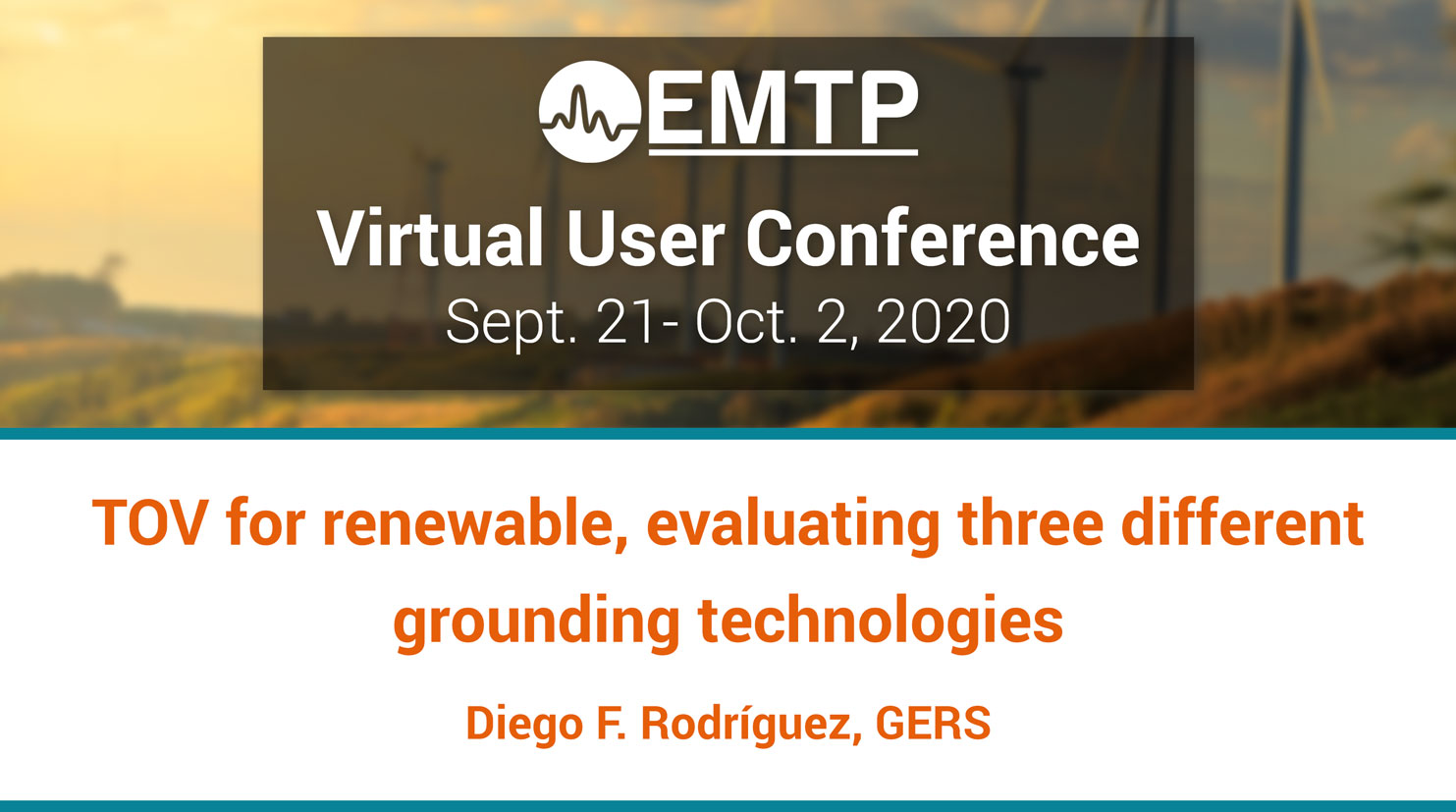
Author(s): Diego F. Rodríguez - GERS
Type:Technical Presentation
Date: 2021-06-17
Abstract
Temporary overvoltages (TOV) are oscillatory overvoltages mainly caused by switching or faults, which are of relatively long duration and undamped or slightly damped. Maximum overvoltages under faulte... see mored conditions can require considerable energy magnitudes absorbed by surge arresters.
These energies may overpass maximum limits and lead to equipment damage.
This project presented a study to identify the maximum TOV at the MV equipment of a PV power plant during fault-clearing events. Two methods of TOV suppression are evaluated, including grounding transformers and fast grounding switches under two different configuraions. An electrical model was elaborated in EMTP to perform the simulation of the transient overvoltage due to the un-balanced fault clearance, considering each inverter of the PV plant. The results show that considering no grounding technologies at the feeders, the energy absorption limit is overpassed in the islanded system.
Therefore, a fast grounding switch or a system with grounding technology at each feeder is needed in order to protect the substation equipment.
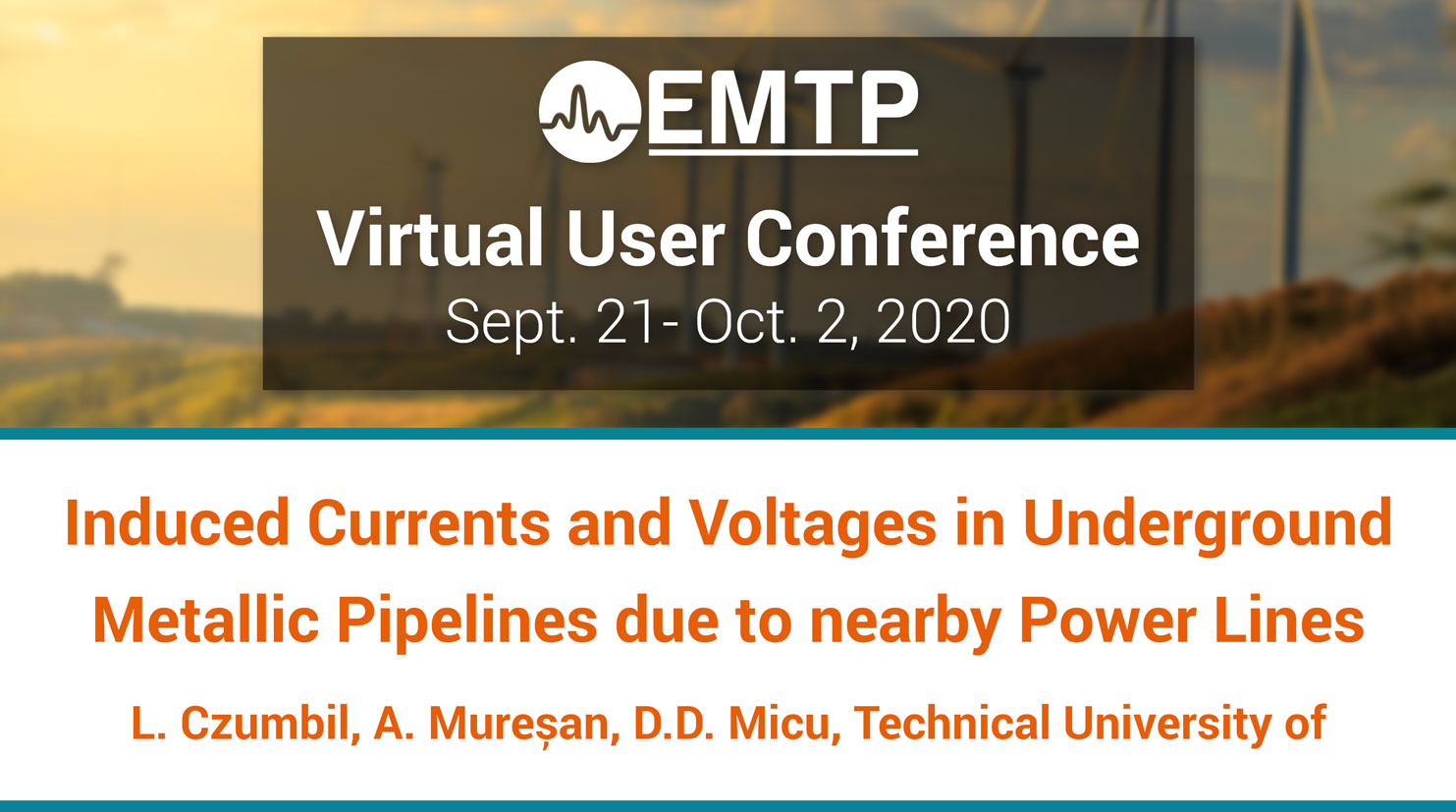
Author(s): L. Czumbil - Technical University of Cluj-Napoca
Type:Technical Presentation
Date: 2021-06-16
Abstract
During the last decades, environmental and economic reasons impose that gas or water pipelines share the same distribution paths with high voltage or medium voltage power lines, to restrain the financ... see moreial and the ecological costs. Therefore, the cases where underground metallic pipelines and power lines share proximal rights-of way for considerable lengths are a common practice.
The electromagnetic interference of power lines upon the metallic buried pipelines is an issue of priority, to avoid the development of induced voltages that could jeopardize the safety of the personnel and the integrity of the pipelines structure. Indeed, the developed voltages and currents can be dangerous for people who touch metallic structures connected with the pipelines or just stand nearby.
Moreover, the induced voltages can result in the corrosion of a pipeline due to electrochemical effect, leading to repair or/and replacement costs and environmental repercussions.
It is worth mentioning that the interference comprises an inductive, a conductive and a capacitive part. The capacitive part can be safely ignored in the case of buried pipelines, since the conductive component is considered only under fault conditions and affects the part of the pipeline near the faulted structure.
The inductive component is present both during faults and normal operating conditions and is the dominant one. Due to the inductive interference, voltages and currents are induced in a buried metallic pipeline.
![[R&D]_EMTP : Recherche et développement](https://www.emtp.com/system/files/imagecache/presentation/slide1_1.jpg "[R&D]_EMTP : Recherche et développement")
![[Protection_Devices]_Étude des courants coupés par les sectionneurs de changemen](https://www.emtp.com/system/files/imagecache/presentation/TechnicalPresentation1.jpg "[Protection_Devices]_Étude des courants coupés par les sectionneurs de changemen")